Verifying AI Output Shouldn't Take Longer Than the Work Itself
AI only saves time if you can verify its work efficiently. Filot audits at two levels, deterministic validation checks and granular cell-by-cell traceability, so analysts review AI-generated models at the speed of reading, not the speed of searching.
AI only saves time if you can verify its work efficiently.
That is still a major problem with general AI tools. Ask ChatGPT or Claude to build a financial model and you can get a plausible workbook quickly. What you often do not get is an efficient way to prove where every number came from, whether the model reconciles, or whether something was hallucinated along the way.
The result is a new bottleneck: review.
Analysts end up retracing values manually against filings, checking formulas, and hunting through source documents. The time saved generating the model gets spent verifying it.
In many workflows, that is inconvenient. In investment research, it is a nonstarter. Verification is not optional.
That is why auditing is built directly into Filot at two levels.
Level 1: Validation checks
The first layer is a bird's-eye view of the model.
Filot registers key statement totals, subtotals, and disclosed KPIs as deterministic validation checks, then compares them directly against the reported figures in the underlying source documents.
This is not an LLM evaluating its own output. It is code checking whether two numbers reconcile.
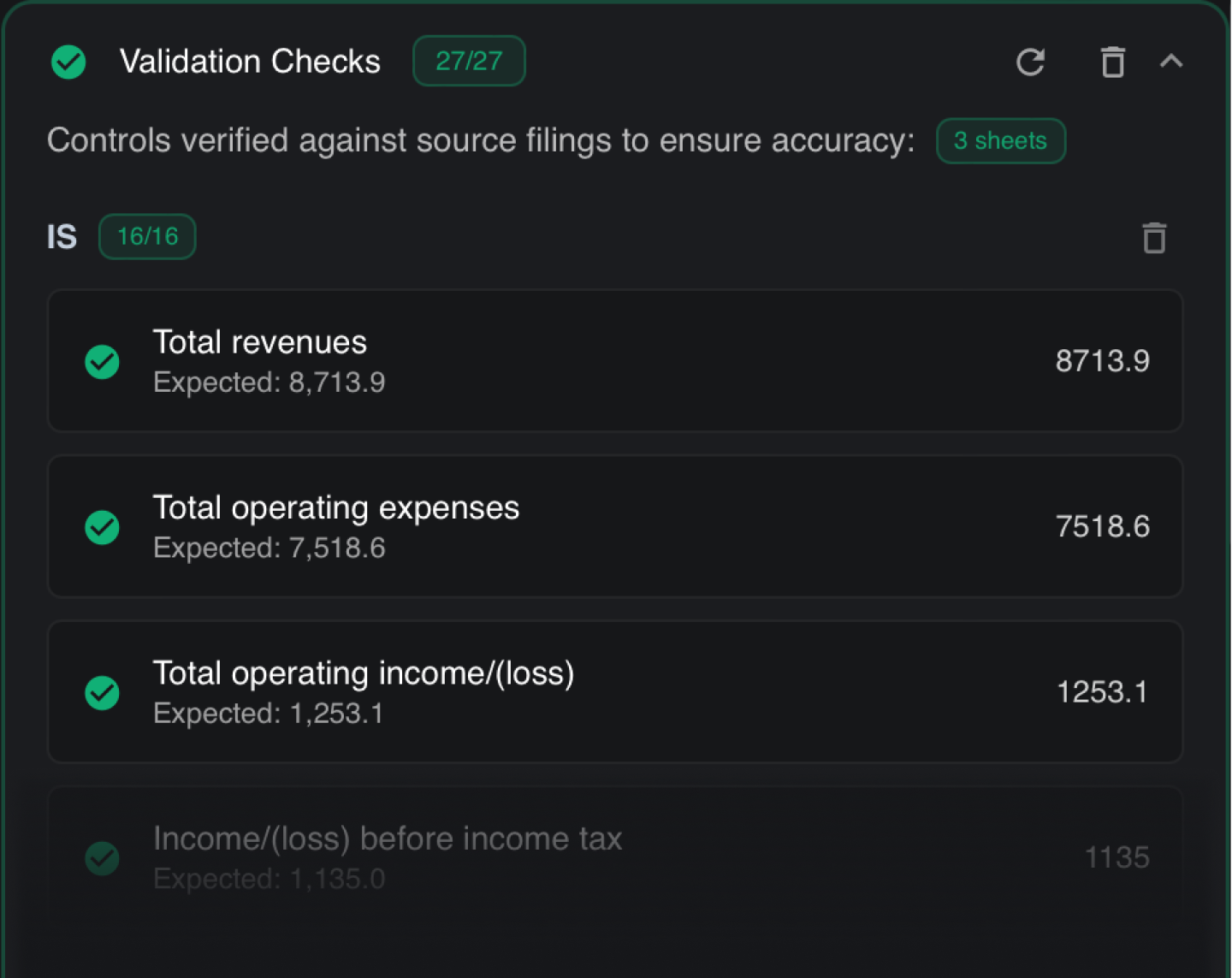
Inside the Audit tab, analysts get a simple pass-or-fail view across the model, grouped by sheet and refreshable on demand. If something stops reconciling, they immediately know where to look.
The checks are anchored to the model itself, so they survive changes such as inserted rows or restructuring.
The goal is simple: answer, at a glance, "Did anything come out wrong?"
Level 2: Granular auditing
The second layer answers a different question: "Where did this number come from?"
Every sourced datapoint Filot places in a model carries a citation back to its source. The citation includes the underlying document, page, and supporting text.
These citations live directly in Excel as comments on individual cells, with links back to the source. So if an analyst wants to verify one number, the evidence is already attached to it.
But checking cells one by one does not scale.
That is where Filot's granular auditing interface comes in.
Analysts can select a range of cells and review all of the underlying sources together. The source document opens alongside the model, with the relevant evidence highlighted for each datapoint. Instead of searching through filings manually, analysts can move through an entire section of the model in sequence.
Calculations are auditable too. If a value is derived from several inputs, Filot traces each component separately back to its underlying source.
The result is that review happens at the speed of reading, not the speed of searching.
Why both layers matter
Validation checks and granular auditing solve different parts of the same problem.
Validation checks tell you whether the model reconciles. Granular auditing shows you exactly why each number is there.
For a quick spot check, the citation is already attached to the cell. For a broader review, the auditing interface lets analysts move through an entire model efficiently.
Together, these layers turn verification from a manual retracing exercise into a fast review process.
That is the real efficiency gain. It is not enough for AI to build the model faster. Analysts also need to be able to verify the result without giving back all of the time AI was supposed to save.
The same layers make the model more accurate
Auditing is not only a review tool. The same checks are enforced on Filot itself while it works.
Filot cannot report a task complete while a validation check is failing. If a total stops reconciling to the filing, it has to find and fix the cause before it can move on. And every citation it places has to actually resolve: the highlighted text in the source document must contain the value it claims to support, or the citation is wrong and the work is not done.
That enforcement is the difference. A general AI tool produces an answer and stops. Filot has to satisfy the same validation checks and audit trails an analyst would use to check its work, before the analyst ever sees it. The result is significantly more accurate output than providers without this enforcement, and a review that starts from a model that already reconciles.
See it in action
In Filot's Audit tab, analysts can review deterministic validation checks across the model and trace individual datapoints directly back to their sources.
Buy-side and sell-side teams are already using this workflow to review AI-generated financial models at scale.
More from Filot
See all →Claude Opus 5.5 Is Now Available on Filot
Anthropic's Claude Opus 5.5 is now available on Filot. It builds more thorough financial models than Opus 5, in less time and at lower cost.
Fable 5.1 Is Now Available on Filot
Anthropic's newest frontier model is now available on Filot. It leads our internal evaluations on long-running financial modeling tasks, and discounted prompt cache reads make it cheaper to run than Fable 5.
Claude Sonnet 5 Is Now the Default on Filot
Anthropic's Claude Sonnet 5 is now the default model powering every Filot workflow — stronger reasoning, better tool use, and improved performance on long-running financial modeling tasks.